Tata Motors enters 2025 with an aggressive model plan that blends refreshed ICE (internal combustion engine) lineups, facelifts, and a rapid push into electric vehicles (EVs). From mass-market city crossovers to flagship electric SUVs, Tata is trying to hold and extend its leadership in India’s value-and-EV segments. This article takes a model-by-model look at the most important Tata launches what to expect, when they might arrive, how they fit into Tata’s EV strategy, and what buyers should keep in mind when shopping in 2025–26.
Why 2025 matters for Tata Motors and Indian buyers
Over the last three years Tata has become the face of affordable electrification in India. The brand’s EV portfolio (Nexon.ev, Punch.ev, Tiago.ev and Harrier.ev among others) and a strengthening line of ICE SUVs (Nexon, Sierra, Harrier, Safari) have allowed Tata to cover both mass and aspirational buyers. Meanwhile, increased competition — from legacy players updating popular models and new EV entries from Mahindra, Hyundai, MG and others — makes Tata’s 2025 roadmap important: it must consolidate its EV gains while refreshing its ICE models to stay competitive on features, price, and perceived value.
In short: 2025 is a balancing act for Tata keep EV momentum running, while protecting volume in the mid-price segments with facelifts and new variants. The rest of this guide breaks down the named models you’ll see in showrooms or test fleets over the next 12–18 months.
Top Tata launches to watch in 2025 (and early 2026)
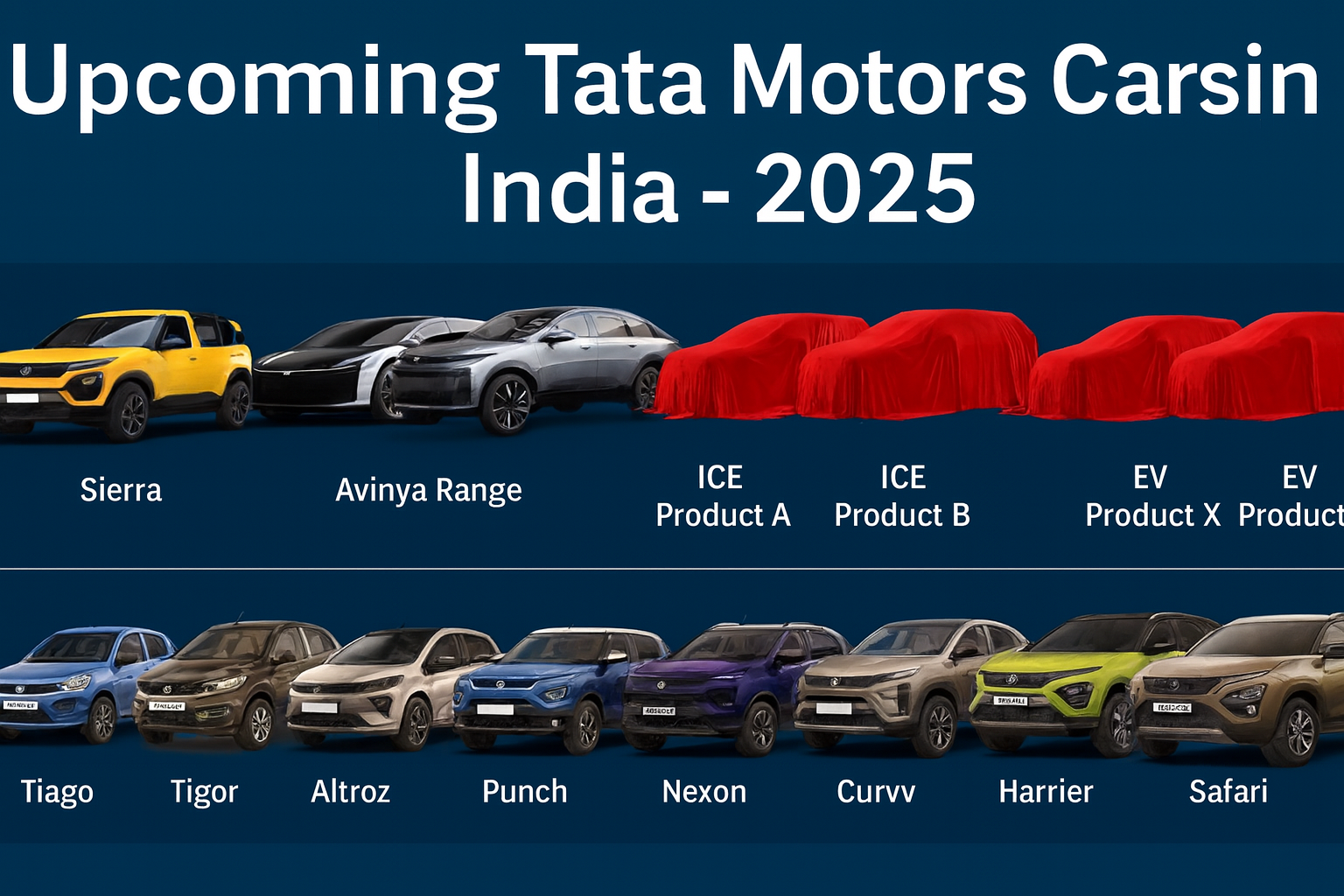
Based on announcements, company pages, industry reporting and dealership leaks, the headline models to watch are:
Tata Sierra (new generation and Sierra EV) a modern revival of a classic nameplate. Tata Motors Cars
Tata Curvv (ICE + Curvv.ev variants) coupe-SUV styling extended into the EV lineup. Tata Motors EV
Tata Harrier (petrol variant and continued EV push) Harrier is being positioned with petrol options plus Harrier EV variants. Tata Motors Cars
Tata Safari (updates and EV planning) Safari remains a flagship name for Tata’s larger SUV buyers. Tata Motors Cars
Tata Punch (facelift / updated ICE and continued EV availability) a fresh look for Tata’s compact SUV to keep its mass appeal.
Tata Avinya (GEN-3 EV architecture and Avinya concepts moving toward production under the Avinya sub-brand) an important signpost for Tata’s long-term EV architecture and premium positioning. Tata Group
I’ll unpack each model in detail below and provide a realistic view of what buyers and fans should expect for specs, pricing, and positioning.
Tata Sierra (2025) retro nameplate, modern product
What is it?
The Sierra name was revived by Tata in 2023–24 as a mid-sized, value-oriented SUV. For 2025 the Sierra continues to be one of Tata’s focal models: the company is expanding variants, and industry sites list Sierra ICE and Sierra EV derivatives as forthcoming in 2025–26. Many outlets track Sierra as a high-volume contributor in Tata’s SUV portfolio. Tata Motors Cars
Why it matters
The Sierra sits in the sweet spot for many Indian buyers — it targets family buyers who want SUV styling at “affordable SUV” pricing. If Tata pushes Sierra into EV variants (or plans a Sierra EV), it becomes a direct competitor to smaller EV crossovers from other manufacturers. Car platforms that can carry both ICE and EV variants give Tata a useful flexibility advantage in a market still transitioning between powertrains.
Expected features & positioning
Expect roomy packaging, family-friendly features (7-seat or flexible 5+2 seating depending on variant), and an emphasis on value for money — safety kit, connectivity, and comfortable interiors designed to appeal to buyers moving up from hatchbacks. Pricing estimates in popular auto portals place the Sierra in an accessible band (with certain trims positioned near ₹11–18 lakh depending on features and powertrain). Tata Motors Cars
Timing
The Sierra has already been launched in some forms and will have continued rollout (higher trims, EV variants or special editions) into late 2025 and early 2026 as Tata expands the line-up. Tata Motors Cars
Tata Curvv (and Curvv.ev lineup) coupe styling and EV intent
What is it?
The Curvv is Tata’s coupe-inspired compact SUV that arrived to give Tata a stylish, premium-leaning option in a crowded segment. Importantly, Tata markets the Curvv with both ICE and EV-specifications: the Curvv.ev is already an item in Tata’s EV webpage, with specs and variant listings. Tata Motors EV
Why it matters
The Curvv shows Tata’s strategy to offer choice: buyers who want coupe-SUV looks can pick ICE or EV powertrains. Curtailing waiting lists and expanding production to meet both demand types is crucial for Tata because the Curvv sits in a segment with high aspirational value.
Notable specs & user expectations
EV variants list ranges and battery options competitive with Tata’s Nexon.ev and Harrier.ev family — expect real-world ranges in the 300–430 km bracket on standard WLTP/Indian test cycles for higher-cap variants, and active feature lists (digital cockpits, ADAS in top trims) as Tata pushes premium tech into the model. Car portals currently show Curvv.ev pricing in the mid-to-high segment of Tata’s EV range. CarDekho
Timing & availability
The Curvv is already in market in various forms; expect continued updates, new features and potentially refreshed trims through 2025 as Tata optimises supply and responds to buyer feedback. CarWale
Tata Harrier (2025) petrol options and Harrier EVs
What is it?
Harrier is Tata’s mid-sized family SUV that sits above the Nexon and below the Safari in the product stack. Historically Harrier has been offered with diesel and, more recently, petrol and EV variants as Tata transitions its powertrain mix. The Harrier 2025 pages show updated Harrier model listings and Harrier ICE pages on Tata’s official site. Tata Motors Cars
Why it matters
Harrier is an important volume and image car for Tata: it brings buyers into showrooms who may later “trade up” to Safari or choose Mahindra/Hyundai alternatives. The addition of petrol variants (or refreshed petrol options) is a strategic play — not every buyer is ready to move to electric, and petrol Harrier variants can increase reach and price competitiveness.
Expected updates
Expect refreshed interiors, more connected features and safety kit parity with rivals. Harrier EV variants will continue to be promoted to buyers who prioritize long-range capability and Tata’s improving EV charging and ownership experience. Staff and media reports indicate Harrier petrol rollouts timed around late 2025 show windows. Tata Motors Cars
Tata Safari flagship rugged family SUV
What is it?
Safari is Tata’s flagship SUV nameplate targeted at family and lifestyle buyers who want space, comfort, and presence. The Safari has historically been the brand’s larger SUV offering and is now available with ICE and — in Tata’s roadmap — future EV derivatives as Tata expands electrification across its larger vehicles. Tata Motors Cars
Why it matters
Safari is the emotional and aspirational flagship for many Tata customers. Keeping Safari modern and offering alternate powertrains keeps Tata competitive among buyers who want large-SUV space but also look for modern tech and economy.
What to expect
Feature-loaded trims — panoramic roofs, superior infotainment, advanced ADAS packages in upper trims — plus potential electrified powertrains (or hybrid options) in the pipeline. Wide availability and competitive pricing for fleet/retail buyers will be part of Tata’s strategy to hold share in the large SUV segment. Tata Motors Cars
Tata Punch (facelift 2025/early-2026) small SUV refresh
What is it?
Punch is Tata’s small, high-seated “micro-SUV” which competes in the city-SUV space. A facelift/updated Punch is widely reported and has already been spied testing on Indian roads; Tata is expected to release updates in late 2025 or early 2026. CarWale
Why it matters
Punch is one of Tata’s volume drivers — it’s accessible, safe and appealing to first-time SUV buyers. A facelift keeps the Punch fresh against renewed competition from Hyundai, Maruti and others.
Expected changes
Visual updates (new LED bar across the boot, refreshed bumpers), interior upgrades (new steering wheel design, improved upholstery), and possible mild powertrain tweaks. The Punch EV line will continue to be an option for India’s urban EV buyers; the facelift mainly concerns ICE variants. Industry pages estimate launch windows around late 2025 into early 2026 with prices still targeted at the affordable end of India’s SUV pricing band. CarWale
Tata Avinya & GEN-3 architecture Tata’s medium-term EV future
What is Avinya?
Avinya started as a Tata concept for GEN-3 electric architecture and a future family of electric products. Tata has public material on Avinya and a statement that the Avinya architecture is meant to underpin the next generation of Tata Passenger Electric Mobility products. The Avinya identity has been shown as a concept (Avinya X and similar) and Tata has referenced moving from concept to production in coming years. Tata Group
Why it matters
Avinya represents Tata’s future EV philosophy: clean-sheet EV architectures designed for efficiency, packaging, and digital experiences rather than conversions from ICE platforms. If Tata brings Avinya-based models to market by 2026–27, they will set the stage for a new generation of Tata EVs with improved range, packaging and premium features. Industry reporting suggests production lines and specific Avinya-branded vehicles will appear 2026 onward, but exact dates and trims remain tentative. CarDekho
Pricing expectations & how Tata positions cars in 2025
Tata’s pricing strategy in 2025 is pragmatic: keep entry points affordable to protect volume, offer premium trims with strong tech and safety features to boost per-vehicle profitability, and price EVs competitively to make electrification accessible. Publicly posted model pages and market portals give broad price bands:
Sierra: affordable-to-mid band (some estimates ~₹11–18 lakh for ICE trims). Tata Motors Cars
Curvv.ev: positioned above mass EVs like Nexon.ev (CarDekho/CarWale list prices in the higher mid-range). CarDekho
Punch facelift: expected to be competitively priced (rumours ~₹6 lakh start for ICE facelift trims), keeping it mass-market focused. CarDekho
Avinya / Avinya-based EVs: expected as higher-value, premium EVs (industry estimates vary widely; production timing could place prices well above Tata’s mass EVs). CarDekho
Remember: these are market estimates from auto portals and industry reporting — final Tata list prices, option packs, and government incentives (which can meaningfully lower on-road costs for EVs) will determine buyer economics at launch.
Tata’s manufacturing & supply outlook why availability matters
A critical practical issue in 2025 is supply and waiting periods. Tata has faced long waiting periods on some models as EV demand rose faster than localized battery and production capacity. For buyers, understanding lead times, dealer allocation policy, and potential waiting lists (especially for popular EV variants like the Nexon.ev or Curvv.ev) should shape purchase decisions. Industry trackers report waiting times for some Tata models and indicate Tata is expanding capacity — but supply tightness can persist when demand spikes. CarWale
Buyer checklist how to choose the right Tata for 2025
If you’re considering a Tata model in 2025, use this checklist to make a practical decision:
Define primary use — city commuting, family trips, intercity travel or mixed use. EVs shine for city and regular intercity trips with reliable charging; long rural runs still favour ICE or hybrids in some regions.
Range reality vs claimed range — for EVs, compare WLTP/official claims to real-world owner reports (auto journalists and owner forums are useful). Tata’s Nexon.ev and Curvv.ev generally deliver competitive real-world range, but heavy AC use or high speeds reduce range. CarDekho
Charging convenience — check public fast-charging availability in your city and Tata’s home charging options. Government subsidies or incentives in some states can lower EV purchase costs.
After-sales & warranty — Tata’s dealer network is among India’s largest; still, evaluate service costs and battery warranty terms for EVs (battery warranty length, degradation guarantees).
Feature / trims mapping — identify must-have features (ADAS, sunroof, digital cluster) and pick trims that include them rather than relying on expensive options.
Total cost of ownership (TCO) — for EVs, compare higher upfront cost against lower running costs; for ICE vehicles, consider fuel economy, service costs and resale expectations.
Waiting period — if you need a car immediately, consider dealer stock or ICE alternatives; if you can wait for a launch model, pre-booking can secure better configurations. CarWale
Technology focus: ADAS, connected services, and software
Tata has pushed modern connected infotainment, digital clusters, over-the-air updates and advanced driver assistance systems (ADAS) into its product line. In 2025, expect Tata to extend ADAS features and software-driven improvements across model lines — especially in higher trims and EV variants. Software differentiation (frequent OTA updates, connected apps for range/charging optimisation) will be a major buyer consideration because it determines daily ownership convenience. Curvv, Harrier, and higher Sierra/Safari trims are likely to get the richest tech stacks. CarDekho
Competition and market dynamics: how Tata stacks up in 2025
By 2025 Tata’s rivals are intensifying efforts:
Mahindra launched new EVs and plans a wider EV range; the company is expanding investment in EV-specific platforms. Reuters coverage of Mahindra’s EV launches shows industry momentum across manufacturers. Reuters
Hyundai, Kia and MG continue to expand their connected and EV offerings, putting pressure on Tata to sustain its cost-to-value ratio and feature content.
Startups and new entrants (localised or China-backed EVs) may push price competition in specific segments.
Tata’s strengths remain in its broad dealer network, strong brand recognition for value and safety, and a quickly growing EV portfolio. But success depends on execution — timely rollouts, keeping waiting periods manageable, and delivering consistent after-sales service.
Practical buying tips for 2025 launches
Book with caution: pre-bookings often require token amounts; read the cancellation and allocation policy carefully.
Wait for first owner reviews: early owner reviews and long-term road tests uncover software bugs, range expectations, and reliability patterns. If you can wait 2–3 months after launch, you can usually get better clarity.
Factor in charging: install home charging where possible; calculate expected charging times at home and on public DC chargers.
Negotiate extras and extended warranty: dealers may have flexibility on accessories, extended warranties, and annual maintenance plans during festive or end-of-year discounts.
